Resources
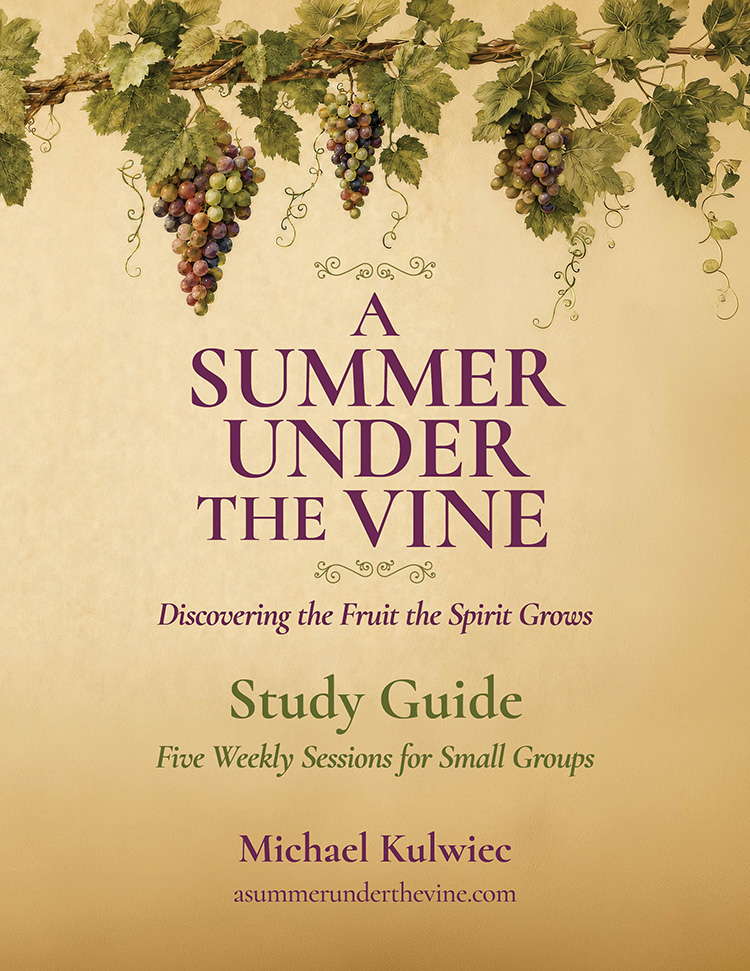
A Summer Under the Vine Group Study Guide
Everything your group needs for five weeks, in one free download. Each session includes the week’s Scripture, questions for your own time with God, questions to talk through together, and something to watch for in the week ahead. The guide is set up for US Letter paper and prints well double-sided. Print as many copies as your group needs.
0.8 MB · 26 pages · Updated October 2026

Week by Week
Open a week to read it here, or download that week as its own PDF to print for your group.
Week One / The Abiding
You Will Have Grapes in Three Years
Book Reading
Read the Preface and Chapter One before you meet (pages vii–ix and 1–19, about 20 minutes).
Michael’s brother-in-law, Paul, looked at two bare sticks in one-gallon pots and saw grapes. God looks at us and sees the likeness of Jesus waiting to grow.
This week is about what the Holy Spirit grows in people who abide in Christ, and why we can’t grow it ourselves.
Scripture Readings
4Abide in me, and I in you. As the branch cannot bear fruit by itself, unless it abides in the vine, neither can you, unless you abide in me. 5I am the vine; you are the branches. Whoever abides in me and I in him, he it is that bears much fruit, for apart from me you can do nothing.
John 15:4–5 (ESV)
16But I say, walk by the Spirit, and you will not gratify the desires of the flesh. 17For the desires of the flesh are against the Spirit, and the desires of the Spirit are against the flesh, for these are opposed to each other, to keep you from doing the things you want to do. 18But if you are led by the Spirit, you are not under the law.
19Now the works of the flesh are evident: sexual immorality, impurity, sensuality, 20idolatry, sorcery, enmity, strife, jealousy, fits of anger, rivalries, dissensions, divisions, 21envy, drunkenness, orgies, and things like these. I warn you, as I warned you before, that those who do such things will not inherit the kingdom of God.
22But the fruit of the Spirit is love, joy, peace, patience, kindness, goodness, faithfulness, 23gentleness, self-control; against such things there is no law. 24And those who belong to Christ Jesus have crucified the flesh with its passions and desires.
25If we live by the Spirit, let us also keep in step with the Spirit.
Galatians 5:16–25 (ESV)
Between You and God
Take your time with these questions, as you read or after, before your group meets. You can write, pray, or simply sit with one. You won’t be asked to share your answers.
- Think about your prayer, Bible reading, and worship this past month. When were you abiding, simply staying close to Jesus? When were you striving, trying to make yourself grow or prove you were doing well? Tell God honestly what you noticed.
- The book asks readers to put their own name in front of Paul’s list in Galatians 5:22–23: ______ is loving, joyful, peaceful, patient, kind, good, faithful, gentle, and self-controlled. Try it. Where did you flinch? Most of us do somewhere. What would you want to say to God about that?
- The curve inward doesn’t always look sinful. It can look like serving to feel needed or praying to feel righteous. It can even look like a committed Bible teacher on a Sunday morning, sure he has it all figured out. Where might your devotion be more about securing your standing than about God?
- A young vine puts everything into roots and wood for years before it fruits. Think back over your life with God. Where did growth happen that you couldn’t see at the time? Where do you need patience with what He’s growing now?
- Have you put your trust in Jesus Christ as your Savior and Lord? When we believe in Him, God seals us with His Holy Spirit (Ephesians 1:13–14), and it’s the Spirit who grows this fruit in us. If you aren’t sure where you stand, read Romans 10:9–10. The prayer near the end of Chapter One can help you express your trust in Him. If you have questions, ask a pastor or a mature Christian you trust to talk and pray with you.
Getting Started
Take a moment to introduce yourselves. Have you ever grown something, a garden, a houseplant, anything at all? What did it teach you about waiting? Your time in Between You and God is yours to keep, but if something stood out, you’re welcome to share it.
To Discuss with Others
- The vine started as two bare sticks, and someone who knew grapes said, “You will have grapes in three years.” Has someone ever seen something in you before you could see it yourself? What difference did their confidence make? The apostle Paul looked at people the same way, seeing the character of Jesus waiting to grow. What might God see growing in you that you can’t see yet?
- Read John 15:4–5 and Galatians 5:16–25. The book’s premise is that we pursue God-centeredness, and the Spirit produces God-likeness. Jesus connects abiding with His words remaining in us and our keeping His commandments (John 15:7, 10). How can prayer, Bible reading, and obedience express dependence on God rather than an effort to secure our standing? How does that change the way you approach spiritual growth?
- The Galatians weren’t careless. They were devout people adding their own effort to what Christ had already done, and Paul was more alarmed by them than he might have been by open sinners. Why is religious flesh so hard to see in the mirror? What might it look like in a group like ours?
- The book describes sin as incurvatus in se (pronounced in-kur-VAH-tus in SAY), Latin for “curved in on oneself.” It pictures a hand made to open outward, closed into a fist. We were made to open toward God and toward other people. Sin closes us around ourselves, so we live for ourselves and answer only to ourselves, as though God isn’t in the room. How is that different from thinking of sin as a list of wrong things we do? If the problem is the direction of the whole person, what does that mean for how we change?
- The chapter describes the Holy Spirit as a person who speaks, teaches, guides, intercedes, and can be grieved. How does that compare with the way you’ve understood Him? What difference does His being a person make to walking by the Spirit?
- Paul writes fruit, not fruits. The Greek word karpos (pronounced KAR-pos) is singular. The book puts it this way: “The Spirit isn’t building nine separate traits. He’s growing one kind of life, and that life looks like Jesus.” How would that change the way someone tries to “work on” patience or kindness?
- Fruit grows gradually, inevitably, internally, and visibly. Which of these encourages you most? Which challenges what you’ve expected from your own spiritual growth?
Close in Prayer
The Week Ahead
Next week turns to love, joy, and peace, the most interior of the fruit. This week, watch for them. Notice someone who loves without being asked, joy that shows up in an unlikely place, or a calm that holds even when nothing around it has changed. When you meet again, share what you noticed if you’d like.
Before you meet again, read Chapter Two, “All You Need is a Bus Ride” (pages 21–55, about 35 minutes).
Week Two / The Interior Life
All You Need is a Bus Ride
Love · Joy · Peace
Book Reading
Read Chapter Two before you meet (pages 21–55, about 35 minutes).
Michael and Pam’s love story starts with a tired girl on a bus and a borrowed shoulder. Before the chapter ever defines love, it shows love asking Michael to open his hand. This week looks at love, joy, and peace, the fruit that begins beneath the surface of a life, in a heart that stays connected to Christ.
Scripture Readings
Love
4Love is patient and kind; love does not envy or boast; it is not arrogant 5or rude. It does not insist on its own way; it is not irritable or resentful; 6it does not rejoice at wrongdoing, but rejoices with the truth. 7Love bears all things, believes all things, hopes all things, endures all things.
1 Corinthians 13:4–7 (ESV)
Joy
16Rejoice always, 17pray without ceasing, 18give thanks in all circumstances; for this is the will of God in Christ Jesus for you.
1 Thessalonians 5:16–18 (ESV)
Peace
17Though the fig tree should not blossom, nor fruit be on the vines, the produce of the olive fail and the fields yield no food, the flock be cut off from the fold and there be no herd in the stalls, 18yet I will rejoice in the Lord; I will take joy in the God of my salvation.
Habakkuk 3:17–18 (ESV)
How They Fit Together
9As the Father has loved me, so have I loved you. Abide in my love. 10If you keep my commandments, you will abide in my love, just as I have kept my Father's commandments and abide in his love. 11These things I have spoken to you, that my joy may be in you, and that your joy may be full.
12This is my commandment, that you love one another as I have loved you.
John 15:9–12 (ESV)
Between You and God
Take your time with these questions, as you read or after, before your group meets. You can write, pray, or simply sit with one. You won’t be asked to share your answers.
- Love sometimes asks us to open our hand and mean it. Is there something you’re holding tightly that God may be asking you to entrust to Him?
- Is there someone in your life right now where the love you feel and the love you’re actually doing have drifted far apart? Is there a face that has become background noise?
- In The Weight of Glory, C.S. Lewis said we are “far too easily pleased,” like a child who keeps making mud pies in a slum because he can’t imagine a holiday at the sea. What’s actually functioning as your source of joy these days, the Blesser or just the blessings? What’s one mud pie you’ve settled for?
- Paul wrote “Do not be anxious about anything” from inside a prison cell (Philippians 4:6). What “cell” are you in right now that is causing anxiety? When did you last bring it to God, with thanksgiving, instead of carrying it yourself one more day?
- Spiritual passivity hides behind spiritual-sounding words like “I’m just giving it to God.” Is there anything you’ve been “giving to God” when what He’s actually asking for is a hard conversation, repentance, or a loving action nobody wants to take?
What You Noticed
Last week you were asked to watch for love, joy, and peace in the people around you. What did you notice? Your time in Between You and God is yours to keep, but if something stood out, you’re welcome to share it.
To Discuss with Others
The Story
- Chapter Two describes a friendship that grew slowly, through years of bad timing, before it became something more. Where has God grown something good in your life out of what looked like bad timing?
Love
Read 1 Corinthians 13:4–7
- Paul calls love a fruit of the Spirit (Galatians 5:22). In John 15, Jesus commands it, but only after “Abide in my love.” The chapter warns that we can get this wrong in two directions. What goes wrong when we treat love as pure feeling, something we wait to arrive? What goes wrong when we treat it as pure willpower? How does abiding change both?
- Every line of 1 Corinthians 13:4–7 is something love does or refuses to do. The book says the opposite of love usually isn’t hatred. It’s indifference. Read the list backward: impatience, envy, rudeness, insisting on your own way. Which of these shows up most easily in an ordinary, busy week?
Joy
Read 1 Thessalonians 5:16–18
- In 1 Thessalonians 5:16, “Rejoice always” uses the word chairete (pronounced KHAI-reh-teh), a command. The fruit, chara (pronounced khah-RAH), is the settled gladness that grows from belonging to Christ. How can obeying the command keep us abiding without turning it into a technique for manufacturing a feeling?
- What mud pies does our culture settle for? Think of someone you know who had real joy in the middle of something hard. What was it rooted in?
Peace
Read Habakkuk 3:17–18
- Habakkuk names every source of security his world depended on, and all of it fails. His vine could be stripped by an invading army. Jesus, the true Vine, cannot fail. What difference does that make in where we place our trust?
- Most of us know someone who seems calm only because they’ve stopped caring. From the outside, it can look a lot like peace. How can you tell someone who has checked out from someone who is trusting God? And when life gets hard, how do you handle it? Is that real peace, or just a way to numb the pain?
How They Fit Together
Read John 15:9–12
- In the reading, Jesus starts with His love, asks us to stay in it, and ends with His joy in us. As the chapter puts it, “Joy says, God is still good. Peace says, I am still held.” Which of those do you need to hear most right now? And why do you think love, joy, and peace come first in Paul’s list, before patience and kindness?
Close in Prayer
The Week Ahead
Next week’s fruit only shows up when someone else is in the room. This week, watch for patience, kindness, and goodness in the people around you, at home, at work, or in line at the store. Who surprised you? When you meet again, share what you noticed if you’d like.
Before you meet again, read Chapter Three, “King of the Promerama” (pages 57–82, about 25 minutes).
Week Three / The Exterior Life
King of the Promerama
Patience · Kindness · Goodness
Book Reading
Read Chapter Three before you meet (pages 57–82, about 25 minutes).
When prom season came around, a youth group decided to skip their school’s dance and throw their own. They called it the Promerama. It looked a little ridiculous and completely wonderful. When the names were drawn for king and queen, the most unlikely kid in the room was crowned king, and everyone cheered. That night showed patience, kindness, and goodness, the fruit that can’t stay private. They need someone else in the room.
Scripture Readings
Patience
9The Lord is not slow in keeping his promise, as some understand slowness. Instead he is patient with you, not wanting anyone to perish, but everyone to come to repentance.
2 Peter 3:9 (NIV)
Kindness
1And David said, “Is there still anyone left of the house of Saul, that I may show him kindness for Jonathan's sake?”
7And David said to him, “Do not fear, for I will show you kindness for the sake of your father Jonathan, and I will restore to you all the land of Saul your father, and you shall eat at my table always.”
2 Samuel 9:1, 7 (ESV)
Goodness
8He has shown you, O mortal, what is good. And what does the Lord require of you? To act justly and to love mercy and to walk humbly with your God.
Micah 6:8 (NIV)
How They Fit Together
12Put on then, as God's chosen ones, holy and beloved, compassionate hearts, kindness, humility, meekness, and patience, 13bearing with one another and, if one has a complaint against another, forgiving each other; as the Lord has forgiven you, so you also must forgive.
Colossians 3:12–13 (ESV)
Between You and God
Take your time with these questions, as you read or after, before your group meets. You can write, pray, or simply sit with one. You won’t be asked to share your answers.
- Think of the one person who tests your patience most right now. When they get to you, do you go cold and shut down, avoid the conversation, or let the frustration build until something gives? What might it look like to talk with God about them, and about how you respond?
- Is there someone you need to forgive, releasing the debt, even if trust can’t be rebuilt yet and reconciliation may never come? Romans 12:18 says, “If possible, so far as it depends on you, live peaceably with all.” What part depends on you?
- For Jonathan’s sake, David went looking for Mephibosheth, a forgotten man living in a nowhere place, with no standing and nothing to offer a king, and gave him a place at his table. In Christ, God has done the same for you. What rises in you when you realize you’ve been given a seat you didn’t earn?
- Where do you already know the right thing to do, but it would be easier to look away or stay quiet? Ask God for the courage to do it.
- Doing good often means never seeing the result. Are you willing to obey and let the Spirit take the credit for whatever it accomplishes, even if you never find out what that was?
What You Noticed
Last week you were asked to watch for patience, kindness, and goodness in the people around you. Who surprised you? Your time in Between You and God is yours to keep, but if something stood out, you’re welcome to share it.
To Discuss with Others
The Story
- A room full of teenagers rallied around Puck, a kid who had never fit in anywhere, the night his name was drawn as king. Nobody coached them to do it. What made them ready for that moment? Who in your world lives on the outside of everything?
Patience
Read 2 Peter 3:9
- God’s patience gives people room to turn. The chapter separates three things we often blur together. Patience restrains retaliation, forgiveness releases the debt, and reconciliation rebuilds the relationship. Why does it matter that these are different? What happens when we expect all three at once?
- Scripture commands us to forgive, but trust has to be rebuilt over time. Joseph wept over his brothers, yet he still tested them before he revealed who he was (Genesis 42–45). What does his story teach about the difference between forgiving someone and trusting them again?
Kindness
Read 2 Samuel 9:1, 7
- Mephibosheth was given a seat at the king’s table for a promise he didn’t even know had been made on his behalf. How is that a picture of what Christ has done for us? How does being given that seat change the way we treat people who have nothing to offer us?
- Niceness wants to keep things comfortable. Kindness wants your actual good, even when it costs something. Has someone ever been kind to you in a way that wasn’t comfortable at the time? What did it do for you?
Goodness
Read Micah 6:8
- Micah 6:8 sums up goodness as acting justly, loving mercy, and walking humbly with God. Kindness offers the cup of cold water. Goodness digs the well, even when it’s slow and no one is watching. Where have you seen someone dig the well?
- Lukewarm neutrality can pass for goodness. It looks like patience, or grace, or not being judgmental, right up until you notice nothing was risked and no one was helped. Why is it so hard to spot in ourselves? What would it look like in a group like ours?
How They Fit Together
Read Colossians 3:12–13
- The chapter describes a sequence. Patience creates the space, kindness fills it with something good, and goodness makes sure what fills it is true. Where have you seen all three at work in the same moment? Why can’t any of us produce them by trying harder?
Close in Prayer
The Week Ahead
Next week looks at the fruit that shows up when life gets hard. This week, notice someone who keeps showing up when it would be easier not to, or who stays gentle under pressure. What do you think is holding them steady? When you meet again, share what you noticed if you’d like.
Before you meet again, read Chapter Four, “It’s Not How I Planned It” (pages 83–114, about 30 minutes).
Week Four / The Test
It’s Not How I Planned It
Faithfulness · Gentleness · Self-Control
Book Reading
Read Chapter Four before you meet (pages 83–114, about 30 minutes).
Chapter Four opens with years of hoping for children, a surgery, an answer to prayer, and an ending no one planned. From there it turns to faithfulness, gentleness, and self-control, the fruit that shows up when no one is applauding. They test whether everything else the Spirit has grown is real all the way down.
Scripture Readings
Faithfulness
22The steadfast love of the Lord never ceases; his mercies never come to an end; 23they are new every morning; great is your faithfulness.
Lamentations 3:22–23 (ESV)
Gentleness
28Come to me, all who labor and are heavy laden, and I will give you rest. 29Take my yoke upon you, and learn from me, for I am gentle and lowly in heart, and you will find rest for your souls.
Matthew 11:28–29 (ESV)
Self-Control
28Like a city whose walls are broken through is a person who lacks self-control.
Proverbs 25:28 (NIV)
11For the grace of God has appeared, bringing salvation for all people, 12training us to renounce ungodliness and worldly passions, and to live self-controlled, upright, and godly lives in the present age,
Titus 2:11–12 (ESV)
How They Fit Together
15Though he slay me, I will hope in him; yet I will argue my ways to his face.
Job 13:15 (ESV)
68Lord, to whom shall we go? You have the words of eternal life,
John 6:68 (ESV)
Between You and God
Take your time with these questions, as you read or after, before your group meets. You can write, pray, or simply sit with one. You won’t be asked to share your answers.
- God’s faithfulness doesn’t depend on ours, and it’s where the faithfulness the Spirit grows in us begins. Where have you seen Him stay faithful to you? And where have your own commitments worn thin, not all at once, just slowly, the way most things actually fall apart?
- Is there a hope or an unanswered prayer you’ve been carrying for a long time? Abraham waited twenty-five years for a promise God had specifically made to him. Our hopes don’t come with that same assurance of a particular outcome. What would it look like to keep trusting God while being honest with Him about what you long for?
- Jesus, with all the power of heaven, described His own heart as “gentle and lowly” (Matthew 11:29). Gentleness is strength under control. Think about how you act when you feel threatened, criticized, or backed into a corner. Who are you in those moments? Is that someone you’re proud of?
- Proverbs 25:28 compares a person who lacks self-control to a city whose walls are broken through. At first doing whatever you want can feel like freedom, until something or someone else moves in and starts running the place. What or who, right now, is telling you what to do that isn’t God? When did it first start having that kind of authority?
- Titus 2:11–12 says it’s God’s grace that trains us to say no. Where have you seen His grace train you, maybe in a failure He met with kindness, or a change you only noticed later? Does your own struggle right now look more like straining harder, or like staying closer to the vine?
What You Noticed
Last week you were asked to notice someone who keeps showing up, or who stays gentle under pressure. What did you see? Your time in Between You and God is yours to keep, but if something stood out, you’re welcome to share it.
To Discuss with Others
The Story
- Chapter Four’s title says it plainly, “It’s Not How I Planned It.” Has there been a time when your life didn’t go the way you planned or prayed? What was still true?
Faithfulness
Read Lamentations 3:22–23
- Lamentations was written in the rubble of Jerusalem, with the city destroyed and the people in exile. Yet the writer anchors himself in God’s character instead of his circumstances. Why does that matter when circumstances are as bad as they get?
- In Genesis 15, only God passed between the pieces of the covenant. Later, Abraham and Sarah both laughed at His timing, and the promise still came. Second Timothy 2:13 says, “if we are faithless, he remains faithful.” Can you point to a time in your life when God was faithful even when you were not? What does that mean to you?
Gentleness
Read Matthew 11:28–29
- When Jesus describes His own heart, He calls it “gentle and lowly.” We usually hear gentleness as weakness. The chapter pictures a trained horse, and a fighter who lets go the moment his opponent taps out. Who in your life is gentle in that sense, strong but under control?
- “Gentleness is being the same person in the argument that you are in the apology.” Galatians 6:1 (NIV) says to restore someone gently, then adds, “watch yourselves,” because we’re capable of the same failure. The book warns that “you can be completely right and completely destructive at the same time.” Why is it so hard to stay gentle when we’re sure we’re right?
Self-Control
Read Titus 2:11–12
- Titus 2:12 says grace trains us, and Paul elsewhere compares that training to an athlete’s (1 Corinthians 9:25–27). The chapter puts it this way: “Self-control was never the absence of desire. It’s desire rightly ordered around what actually matters.” How is that different from white-knuckling your way past temptation? Where do you see the counterfeits, like rule-keeping, or looking disciplined only where people can see?
- Jesus could have called more than twelve legions of angels and chose not to (Matthew 26:53). In the wilderness and in Gethsemane, He refused to use His power for Himself. What does His restraint teach us about self-control? Who was He holding back for?
How They Fit Together
Read Job 13:15 and John 6:68
- Faithfulness, gentleness, and self-control show up when no one is applauding. Job kept trusting while he wrestled, and Peter stayed when others walked away. What keeps someone standing when life isn’t how they planned it? Where have you seen it?
Close in Prayer
The Week Ahead
The epilogue looks at the small things that can spoil a harvest, and at what keeps fruit growing. This week, notice what’s shaping you, the voices you listen to, the things you watch and read, and the habits that fill your days. Which of them help you stay connected to the vine, and which ones pull you away? When you meet again, share what you noticed if you’d like.
Before you meet again, read the Epilogue, “Almost Fruitless” (pages 115–129, about 15 minutes).
Week Five / The Reality
Almost Fruitless
Book Reading
Read the Epilogue before you meet (pages 115–129, about 15 minutes).
Late one night, a whoosh and a thud came from the backyard. When the outside lights came on, a wall of green was pressed flat against the back door, the market lights still glowing in the leaves. The grapevine had come down. Termites had been hollowing out the posts that held it up. The Epilogue starts there and looks at what threatens fruit and what protects it, from hungry critters and a lime tree with no taste to the pruning that comes before a harvest. It ends where the summer did, at a table under the vine.
Scripture Readings
Little Foxes
15Catch the foxes for us, the little foxes that spoil the vineyards, for our vineyards are in blossom.
Song of Solomon 2:15 (ESV)
The Lime Tree
17So, every healthy tree bears good fruit, but the diseased tree bears bad fruit. 18A healthy tree cannot bear bad fruit, nor can a diseased tree bear good fruit. 19Every tree that does not bear good fruit is cut down and thrown into the fire. 20Thus you will recognize them by their fruits.
Matthew 7:17–20 (ESV)
Pruning
2Every branch in me that does not bear fruit he takes away, and every branch that does bear fruit he prunes, that it may bear more fruit.
John 15:2 (ESV)
Under the Vine
10In that day each of you will invite your neighbor to sit under your vine and fig tree, declares the Lord Almighty.
Zechariah 3:10 (NIV)
Between You and God
Take your time with these questions, as you read or after, before your group meets. You can write, pray, or simply sit with one. You won’t be asked to share your answers.
- The trellis posts looked fine from the outside, but termites had been working through the middle of them for who knows how long. Is anything hollowing you out from the inside that no one else can see yet? What would you want to say to God about it?
- The lime tree looked like the real thing from every angle and had nothing behind it. Looking honestly at your own life, has that ever been true of you? Ask God to show you what you may not have been able to see for yourself.
- Some of what you scroll through probably feeds you, and some of it may not. Think about the voices in your feed over the past few weeks. Are they encouraging more love and peace in you, or something else, like impatience or a low hum of anger that’s easy to mistake for conviction? What might you want to keep, and what might you want to let go?
- Every winter the vine is cut back to its trunk and about ten thin canes. The canes that bore this year’s grapes are cut away, and the ones that stay will carry next year’s fruit. What might the Father be pruning in your life right now? Could what looks like loss be what next season’s fruit depends on?
- Your abiding space can be anywhere you make time and space for Him, your bed with His Word open, your car loud with a worship song. Where is yours?
What You Noticed
Last week you were asked to notice what’s shaping you, and which things help you stay connected to the vine. What did you find? Your time in Between You and God is yours to keep, but if something stood out, you’re welcome to share it.
To Discuss with Others
The Story
- The vine came down in the night, and it took neighbors to lift it back up. When has your community helped carry something you couldn’t lift alone?
Little Foxes
Read Song of Solomon 2:15
- The backyard critters eat away at the grapes one bite at a time. In Song of Solomon 2:15, little foxes threaten a blossoming vineyard, a picture of love and what can spoil it. The book applies that image to the small compromises that damage growing fruit in our lives. Why are those compromises easy to overlook? Who could you trust to help you recognize and address them?
The Lime Tree
Read Matthew 7:17–20
- You can’t tell a counterfeit by looking at it. You can only tell by tasting what it produces. How do we taste the fruit in our own lives? Are you the best judge of your own? Who in your life would tell you honestly whether your fruit is sweet and real, or as tasteless as that lime?
- It’s easy to trust a voice that always agrees with us. Influencers and even AI can agree with us so often that it starts to feel like confirmation, even like God nodding along. Jesus said we would recognize false prophets by their fruit (Matthew 7:15–16). Have you ever been fooled by something online or on social media? What does it look like to test the voices we listen to most?
- Most of us know someone who is remarkably kind and doesn’t follow Christ. Their kindness to us is real, a reflection of the image of God they bear and His goodness to all (Psalm 145:9). But the fruit of the Spirit grows only from abiding in Christ (John 15:5). How does that change the way you see the kind people in your life who don’t yet know Him?
Pruning
Read John 15:2
- The Father prunes branches that are already bearing fruit. Why would He cut back what’s growing well? Where have you seen a loss turn out to be what the next season’s fruit depended on?
Under the Vine
Read Zechariah 3:10
- The book opens and closes with Zechariah 3:10, an invitation to sit together under the vine. Looking back over these five weeks, what has this group given you? Where have you seen fruit growing in the people around this table?
Share Communion (Optional)
On the last Sunday under the vine, we shared communion, with bread and with juice pressed from the grapes we had watched ripen all summer. We ate and drank and remembered Jesus, whose life was given for us, and whose life now flows through us. And we remembered that fruit only grows on a branch that stays connected to the vine.
If your group would like to close the study the same way, the table doesn’t have to be under a vine. You can gather where you are to remember Jesus and give thanks together.
Churches practice communion in different ways. Follow the guidance of your church about sharing it in a small group. If sharing communion isn’t right for your group, read the passage below together and close in prayer, giving thanks for what Christ has done.
Before sharing the bread and cup, take a quiet moment to examine your heart, confess your sins to God, and give thanks for His grace. Communion is for those who have put their trust in Jesus Christ. If you haven’t yet, you’re welcome to sit with the group and listen. Our prayer is that you would come to know Him. The prayer near the end of Chapter One offers a place to begin, and you can always ask your group leader or someone you trust to talk and pray with you.
23For I received from the Lord what I also delivered to you, that the Lord Jesus on the night when he was betrayed took bread, 24and when he had given thanks, he broke it, and said, “This is my body, which is for you. Do this in remembrance of me.” 25In the same way also he took the cup, after supper, saying, “This cup is the new covenant in my blood. Do this, as often as you drink it, in remembrance of me.” 26For as often as you eat this bread and drink the cup, you proclaim the Lord’s death until he comes.
1 Corinthians 11:23–26 (ESV)
Close in Prayer
Going Forward
The study ends here, but the vine keeps growing its fruit.
Love · Joy · Peace · Patience · Kindness · Goodness · Faithfulness · Gentleness · Self-Control
You don’t grow fruit by trying harder.
You grow it by staying connected.
Keep making room for Jesus in your ordinary days, trusting the Spirit to grow His fruit in you. And remember the promise the book began with, God’s promise to His people through the prophet Zechariah. “Each of you will invite your neighbor to sit under your vine and fig tree” (Zechariah 3:10, NIV).
What you’ve received is meant to be shared, maybe over a meal or a long conversation, somewhere a person can bring their questions and be heard. There is room at the table. Who could you invite to sit under the vine with you?
One Fruit, Nine Displays
You don’t grow fruit by trying harder.
You grow it by staying connected.
The Interior Life / Love, Joy, Peace
Who you are before anyone else is even in the room.
- Love is action, not a feeling you wait to fall into.
- Joy is gladness rooted in who God is, not in how circumstances happen to be going.
- Peace is wholeness rooted in reconciliation with God, not the mere absence of conflict.
The Exterior Life / Patience, Kindness, Goodness
The interior life walking into a room with another person in it.
- Patience is steady grace with people, not just endurance of hard circumstances.
- Kindness is love that’s become tangible.
- Goodness is what’s right, put into action, even when it costs something.
The Test / Faithfulness, Gentleness, Self-Control
Who you are after everyone else has left the room.
- Faithfulness is consistency.
- Gentleness is integrity of manner.
- Self-control is the integrity of the interior life.
From A Summer Under the Vine: Discovering the Fruit the Spirit Grows · asummerunderthevine.com
For Group Leaders
Invite Your Group
An email and two texts, ready to copy and send
Copy an invitation, fill in the details in brackets, and send it a week or two before your first meeting.
Subject
Message
Text Message
Reminder Text
Send 2 or 3 days before you meet.
For Group Leaders
Notes for Leaders
What to know before you lead the study
Before you begin
Send the invitation a week or two ahead so people have time to get the book and read the Preface and Chapter One. If your group is just starting and hasn’t read yet, use your first meeting to get to know each other and read Week One’s Scripture together, then meet again for Week One.
Each meeting
Most groups need 60 to 90 minutes. Open with Getting Started or What You Noticed, read the Scripture aloud, and choose the questions that fit your group. You won’t get to them all, and you don’t need to. Close in prayer.
Between You and God stays private
Those questions are for each person’s own time with God. Please don’t ask anyone to share their answers. If someone chooses to, welcome it.
Let people pass
Any question can be skipped. A simple “Would anyone like to share?” leaves room for quiet people without putting anyone on the spot.
A few tender moments
- Week One asks whether each person has received the Spirit of God and points to a prayer in Chapter One. Someone may be considering faith for the first time. Be ready to talk or pray with them afterward.
- Week Four opens with a story of hoping for children and an answer that didn’t come the way anyone prayed. Some in your group may be carrying their own unanswered prayers or grief. Let them share as much or as little as they want.
- Week Five asks about kind people who don’t follow Christ. For some, that means a spouse, a parent, or a close friend. Keep the conversation gracious.
Communion is optional
Week Five includes an optional time of communion. Churches practice it differently, so follow your church’s guidance, and check with your pastor if you’re unsure. If communion isn’t right for your group, read the passage together and close in prayer.
The original group met over breakfast. Something to eat helps people settle in and talk.